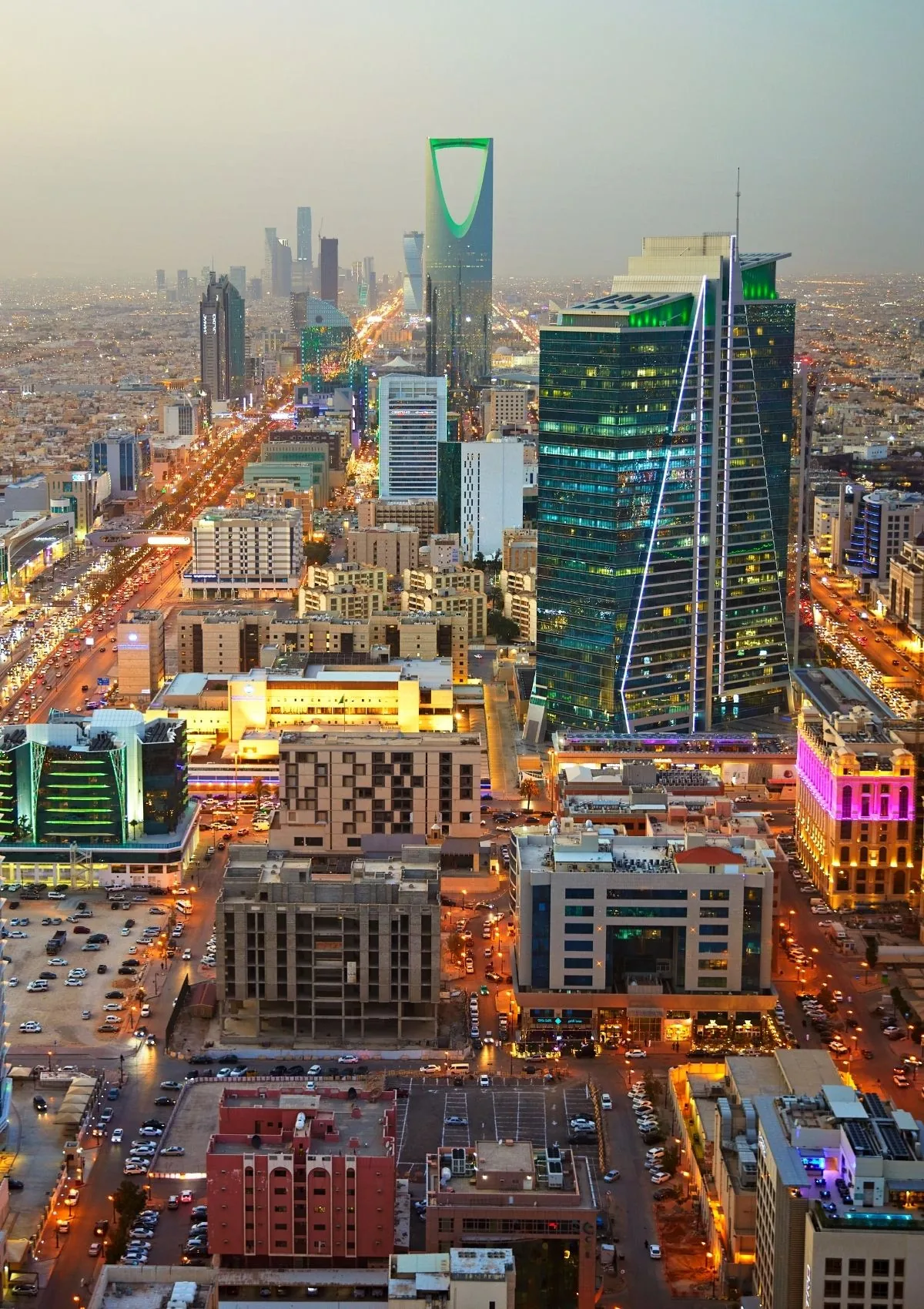

Riyadh's business district lit at dusk, the Kingdom Centre on the skyline
Saudi Arabia flag

Saudi Arabia Business Culture, Work Culture & Etiquette

Business practice guide · informed by benchmark data and by decades of practitioner work at Global Business Culture

The elevator pitch

Where business runs on relationships, wasta, and hospitality, communication is warm face-to-face and diplomatic on difficult matters, and Vision 2030 is transforming the pace. Patience, the right introduction, and cups of gahwa (Arabic coffee) open doors that credentials alone don't.

Where in the world
Saudi--:--
You--:--
—
Population
~36 million
Main hubs
Riyadh
Jeddah · Dammam · Mecca · NEOM (planned)
Language
Arabic
English widely used in business
Currency
SAR · ﷼
Timezone
AST (UTC+3)
No daylight saving

Watch outFree

The five mistakes we see most often with Saudi colleagues.

Even seasoned operators trip over these.

1
Trying to skip the relationship-building phase. Saudi business runs on personal trust and wasta. Trying to close after one meeting rarely works. Invest in the relationship (many meetings, coffee, majlis attendance) before the business follows.
2
Ignoring the Ramadan rhythm. During Ramadan (roughly one month, dates shift annually), work hours shorten significantly, energy dips, decisions slow. Iftar becomes the main social event. Plan around it. Don't work through it.
3
Missteps with gender interaction. Do not offer to shake hands with the opposite gender unless they extend first. Modest dress matters, especially outside international compounds. Women in business have grown rapidly under recent reforms but norms still vary. Follow the counterpart's lead.
4
Causing loss of face in public. Direct public criticism, contradiction of a senior, or humiliation of a junior in a meeting cause serious relationship damage. All difficult messages happen privately, softened, ideally through a trusted intermediary.
5
Bringing alcohol or expecting it at business meetings. Alcohol is illegal in Saudi Arabia and its consumption unacceptable. Do not bring it as a gift, do not expect it at business meals, and avoid mentioning it as a social lubricant option.

Try one nowFree

Practice working with Saudi Arabia.

Ten situations you will actually meet, each with three plausible answers. Start with this one.

Scenario 1 of 10 · Relationship & Trust

Your fourth meeting in Riyadh and each one has opened with gahwa and dates and twenty minutes of conversation that is not about the project. You are behind schedule, so at the fourth you thank your host, decline the coffee and suggest getting straight into the numbers.

What did that cost?

Module and guide

Learn Saudi business culture.

The same nine topics, twice over: taught in the module, carried in the guide. Both are included in a subscription.

🔒 Subscription
🎓

eLearning module

About 30 minutes · nine topics · video and worked examples

A guided walk through how business is actually done in Saudi Arabia, with questions along the way so it lands. Nothing is scored and no result is reported: the questions are there to make it stick, not to test you.

Stop whenever you like. Your progress is saved, it resumes where you left off, and it stays on your dashboard until you finish it.

What it covers

  • Economy
  • Society
  • Key country values
  • Management style
  • Team
  • Communication style
  • Meetings
  • Business etiquette
  • Five key recommendations
Unlock with subscription →
🔒 Subscription
📄

Quick guide, four pages

A4 · built to print · no wifi needed

The same ground in a form you can carry. The facts you need before you land, the four values that explain most of the behavior, then the practical detail on how work gets done.

Print it and take it into the room, or read it on the plane the day before a trip to Saudi Arabia.

On the four pages

  • Country facts
  • Economy and society
  • Four core values
  • Management style
  • Team
  • Communication
  • Meetings
  • Etiquette
  • Top five recommendations
Unlock with subscription →

Your first 30 daysFree

Checklist for working with Saudi colleagues, tick as you go.

Small moves that show you've done the work.

When activity slowsFree

Saudi business calendar, key dates to know.

When Saudi business slows and decision-makers are away.

One month, shifts annually (~11 days earlier each year)
Ramadan (holy month of fasting)
Work hours shorten to ~6 hours in many sectors. Decisions slow, new initiatives get pushed. Iftar (sunset meal) becomes the main social event. Plan around it seriously.
Immediately after Ramadan (moveable)
Eid al-Fitr (end of Ramadan)
Public holiday, typically 5-10 days. Businesses close; families gather. Response times drop for a week either side.
Roughly 2 months after Eid al-Fitr
Eid al-Adha (Festival of Sacrifice)
Public holiday, typically 5-10 days. Businesses close. Major religious observance: many perform Hajj (pilgrimage to Mecca).
23 September
Saudi National Day
National public holiday. Celebrations across the country. Often bridged with the weekend.
22 February
Saudi Founding Day
Newer national holiday (established 2022). Public holiday marking the founding of the first Saudi state.
June to September
Summer heat
Extreme heat (often 45°C+) shapes business rhythm. Many families travel abroad; decision-makers away. Ramadan and summer often overlap.

Against your country, or your own experienceFree

How Saudi Arabia compares.

Where Saudi Arabia sits on the five dimensions. Add your own country or your assessment scores, and click any row for detail.

Relationship & Trust Click to expand
Trust built through relationshipTrust built through delivery
Saudi Arabia

What this means in practice

Saudi business trust is built through personal relationship, shared time, and trusted introductions. Wasta, the network of personal connections and influence, often matters more than credentials or pitch quality.

What to watch for

  • A single meeting rarely closes anything. Expect many rounds and social occasions.
  • Warm introductions from trusted intermediaries open doors that cold outreach cannot.
  • Accepting hospitality (gahwa, dates, meals, majlis) is baseline respect: refusing is a signal.
Communication & Feedback Click to expand
Meaning carried in the situationMeaning stated in words
Saudi Arabia

What this means in practice

Saudi business communication is warm on the surface and indirect on difficult matters. Face (protecting dignity) shapes what can be said and how: direct pushback is unusual.

What to watch for

  • "Yes" or "in sha' Allah" often means "I heard you". Probe gently for genuine commitment.
  • Direct public criticism damages face severely. Deliver concerns privately.
  • Silence and diplomatic phrasing often signal "no" or "not now". Read the space between the words.
Decisions & Agreement Click to expand
Guided by role, agreed in advanceGuided by contribution, agreed in the meeting
Saudi Arabia

What this means in practice

Saudi decisions typically rest with the senior person (often the family head) after private consultation. Meetings often confirm what has been shaped elsewhere; junior views are collected privately if at all.

What to watch for

  • Pushing for a decision without prior groundwork rarely works. Brief informally first.
  • Family businesses often need the patriarch's approval: timelines can be long.
  • Foreign timelines pressed too hard damage trust: patience matters.
Accountability & Ownership Click to expand
Belongs to the team and its leaderBelongs to the named person
Saudi Arabia

What this means in practice

Accountability is tied to the reporting line, with seniors clearly leading. Family businesses dominate; titles carry weight (Sheikh, Prince, Dr.). Personal loyalty often drives outcomes more than formal roles.

What to watch for

  • Public individual blame causes serious loss of face. Correct privately, protect the person.
  • Titles are used and expected: Sheikh, Al-Prince (for royalty), Dr., Eng. all matter.
  • Escalation goes carefully up the reporting line: skipping levels damages relationships.
Planning & Adaptability Click to expand
Prepare fully, then startStart early, refine as you learn
Saudi Arabia

What this means in practice

Saudi business blends ambitious Vision 2030 strategic planning with traditional flexibility. Government-connected projects run at scale; day-to-day execution remains adaptable and relationship-driven.

What to watch for

  • Rigid adherence to plan can feel inflexible. Leave room for adjustment.
  • Government-connected megaprojects (Vision 2030, NEOM) move on strategic timelines.
  • Personal contacts often unlock what formal processes stall.

Quick answersFree

Common questions about working with Saudi Arabia.

How should I approach first business meetings in Saudi Arabia?

Firm handshake with the same gender only. Do not offer to shake hands with the opposite gender unless they extend first: many Saudi women (and men) prefer not to. Address seniors by title + surname (Sheikh Ahmed, Dr Al-Saud). Small talk covers family, travel, sport.

What is the business communication style in Saudi Arabia?

Warm face-to-face; diplomatic on difficult matters. Face matters deeply. Direct public criticism damages relationships significantly. Concerns are raised privately, softened, often through intermediaries.

How important is punctuality in business meetings in Saudi Arabia?

Punctuality expected in international sectors and formal meetings. Weekends are Friday-Saturday. Business day interrupted by prayer times (five daily): meetings may pause. Ramadan shortens working hours significantly.

How are business decisions made in Saudi Arabia?

Decisions typically rest with the senior person after private consultation. In family businesses, the patriarch's approval may be needed even for delegated decisions. Patience is essential.

How is feedback given in workplaces in Saudi Arabia?

Feedback is delivered privately and with care for face. Public criticism is deeply damaging. Praise the team, not the individual, in group settings. Personal recognition happens one-on-one.

What are the business gift-giving and hospitality norms in Saudi Arabia?

Hospitality is sacred: gahwa (Arabic coffee), dates, meals. Modest gifts welcomed; extravagance runs into compliance concerns. No alcohol. Do not bring or expect it. During Ramadan, hospitality shifts to evening iftar meals.